

Why are Most 3.5-inch TFT Displays Connected via an MCU Interface?
The parallel interface of MCU is mainly applicable to: monochrome character-type LCD, monochrome graphic-type LCD, and small-sized TFT color screens (usually 3.5 inches and below). Due to its simple driving and fast development, it is very suitable for embedded systems directly controlled by single-chip micro-controllers. Among various display interfaces, the MCU interface is widely used in small-sized TFT color screens. Especially in devices using embedded micro-controllers as the main control, the MCU interface can simplify system connections, reduce the complexity of hardware design, and provide convenience for graphic interface development.
What is MCU Interface?
The so-called MCU interface is also known as the parallel interface (Parallel Interface). There are two types of this interface: Intel 8080 timing and Motorola 6800 timing. The most common one is 8080. The MCU interface is a common parallel or serial display communication method. In TFT LCD modules, the MCU interface usually communicates with the main control chip through the command register and the display data register. The main control sends instructions, pixel data, and necessary control signals to achieve image display. Unlike the RGB interface that continuously transmits pixel data, many MCU interfaces have TFT display modules that integrate display driver ICs and memory inside. After the main controller writes the image data into the memory of the display controller, the display can continuously refresh the screen by itself, without the need for the main controller to continuously send the entire image data.
In application fields such as industrial control, intelligent instruments and meters, medical equipment, household appliances and embedded terminals, 3.5-inch TFT color display screens are a common display solution. For product development engineers, choosing the appropriate display screen not only requires considering resolution, brightness, color performance and display size, but also needs to comprehensively evaluate interface type, main control chip performance, system cost and software development difficulty.
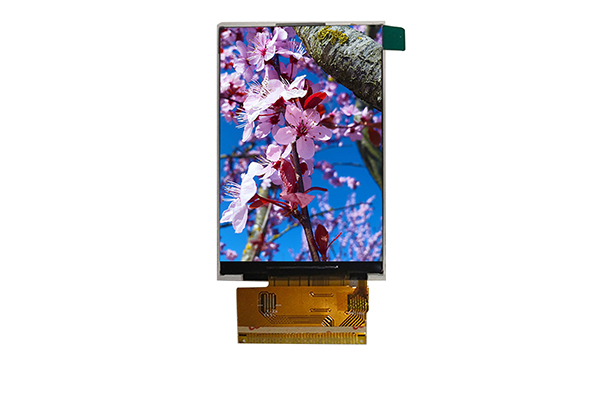
Why are 3.5 inch TFT displays typically equipped with MCU interfaces?
1. The resolution is sufficient for use
2. The requirements for the main controller are low, and the overall cost can be controlled
3. The initialization is simple, the power-on process is fast, and it is stable.
4. The supply chain is mature, and there is a large customization space.
Regarding the 3.5 inch TFT display, several FAQ as below:
Q1: Can the MCU interface display dynamic videos?
Yes, but the smoothness depends on the screen refresh rate. Simple animations, scroll bars, progress bars can be played without issues; for playing high-definition smooth videos, it is recommended to use the RGB interface or reduce the resolution.
Q2: 8-bit and 16-bit buses, which one to choose?
The 16-bit bus offers faster screen refresh and better color reproduction; the 8-bit bus saves pins and is suitable for controllers with limited pins. Both can be used at 320x240, depending on your pin and speed requirements.
Q3: Can this screen be made with full-view (IPS) technology?
Yes. 3.5-inch models can adopt the IPS full-viewing-angle solution. The viewing angle extends from approximately 12 o'clock on the top.
Q4: Are there any differences between the industrial environment and the ordinary screen?
Yes. For industrial scenarios, attention should be paid to wide temperature range (-30 to 80℃), high brightness, anti-static properties, and anti-glare features. For the same 3.5-inch TFT Module, the material selection and testing standards for industrial and consumer grades are completely different. When selecting the components, it is essential to clearly specify the usage environment.