

What is An Embedded Industrial All in One Device?
In fields such as industrial automation, intelligent equipment manufacturing, and edge computing of the Internet of Things, traditional split-type industrial control devices have long been unable to meet the requirements of modern, integrated, and compact equipment design. In the past, industrial sites commonly adopted a combination scheme of 'industrial control host+ independent display+external accessories', which had complicated equipment wiring, occupied a large amount of space, had poor stability, and had extremely high maintenance costs in the future. With the iterative upgrading of industrial hardware technology, industrial all-in-one machines gradually replaced traditional split devices and became the core hardware for industrial intelligent transformation. And embedded all-in-one devices, as the mainstream sub-category of industrial all-in-one machines, have been widely applied in various harsh industrial scenarios thanks to their core advantages of integrated integration, high adaptability, and high stability.
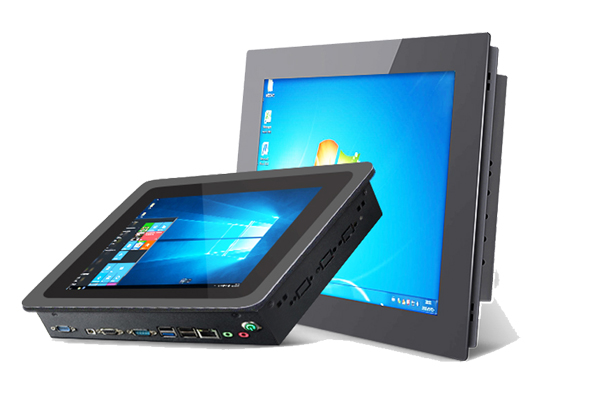
What is an industrial all-in-one machine?
The Embedded industrial all-in-one PC are integrated intelligent touch terminals specifically designed for complex industrial working conditions. They belong to the core category of industrial all-in-one machines and are closed integrated devices that combine industrial-grade LCD display modules, touch interaction units, embedded main control motherboards, storage modules, industrial I/O interfaces, and passive cooling systems. Unlike civilian all-in-one machines and ordinary commercial touch devices, this equipment completely eliminates redundant structures and adopts a standardized embedded installation architecture. It does not require external hosts, displays, keyboards, and mice, and can independently complete the entire process of data acquisition, equipment control, human-computer interaction, edge data computing, signal transmission, etc. It is a dedicated embedded intelligent terminal device for industrial scenarios.
From the perspective of structural design, the embedded industrial all-in-one PC adopts the industry-standard installation mode of back-mounted and front-panel exposed. The machine body is thin and compact, and can be directly embedded into the equipment cabinet, the panel of the automated equipment, or the interior of the intelligent terminal housing. After installation, the screen panel is flush with the surface of the equipment, without any protruding structure. This not only ensures the overall integration and aesthetic appearance of the equipment, but also significantly improves the sealing performance and space utilization of the equipment.
The embedded all-in-one machine is a specifically optimized integrated model, with its core advantages focusing on "embedded adaptation, sealed stability, and minimalist integration". The entire machine adopts a fully enclosed, hole-free body. The front panel generally meets the IP65 level of dustproof, waterproof, and oil-resistant standards, and can directly withstand splashing water, dust accumulation, and oil erosion in industrial environments. There are no external cooling components or extra interfaces on the body. All lines and hardware are integrated within the body, and its anti-vibration and anti-electromagnetic interference performance far exceeds that of ordinary industrial all-in-one machines. At the same time, the embedded all-in-one machine does not require a separate placement space. It can deeply integrate into various automation equipment, intelligent terminals, and cabinet systems, making the equipment more streamlined and with a higher degree of integration, fully adapting to the design trend of modern intelligent equipment.
The core structure and technical characteristics of the embedded industrial all-in-one machine
The core advantages of the embedded industrial all-in-one machine stem from its specialized and industrialized structural design and technical configuration. Its core features are concentrated in four dimensions: protection capability, heat dissipation design, hardware integration, and environmental adaptability. These are the core supports that enable it to operate stably and continuously in industrial environments.
1. Fully enclosed industrial-grade protective structure
The entire embedded all-in-one machine adopts an aluminum alloy integrated die-casting for the body, featuring a sturdy structure, resistance to wear and tear, and impact resistance. It is suitable for industrial equipment operating in environments with frequent vibrations and mechanical impacts. The body has no ventilation holes or exposed gaps, achieving a completely enclosed structure. This prevents dust, moisture, and oil from entering the internal components, effectively protecting the mainboard, display module, touch layer, and other core hardware.
2. Fanless Passive Cooling System
Unlike the fan-driven cooling method used in traditional industrial control equipment, the embedded industrial all-in-one machine adopts a passive cooling technology that utilizes the overall heat conduction of the metal body. Through a high thermal conductivity aluminum alloy body, the heat generated by the hardware operation is quickly conducted and dispersed. This design not only completely eliminates the risks of dust accumulation, noise, and equipment failure and downtime caused by fans, but also significantly reduces the power consumption and operation and maintenance costs of the equipment. The device can operate continuously without interruption for 7×24 hours, with an average fault-free operation duration of up to tens of thousands of hours, fully meeting the needs of all-day operation in industrial production.
3. Stable operation in wide temperature and pressure ranges
Civilian touch control devices and ordinary commercial all-in-one machines can only operate in normal temperature environments. However, embedded industrial all-in-one machines have been optimized for extreme temperature conditions in industrial settings, supporting operation in an ultra-wide temperature range of -20℃ to 70℃. They can be adapted to low-temperature outdoor conditions in the north, high-temperature production environments in workshops, and high-temperature scenarios inside enclosed equipment. At the same time, the equipment supports wide voltage input, which is suitable for voltage fluctuations and unstable power supply in industrial scenarios, effectively avoiding equipment restarts, crashes, and hardware damage caused by abnormal voltages, ensuring the continuity of industrial production and equipment operation.
4. Rich industrial-level expansion interfaces
As an industrial control terminal, the embedded all-in-one machine is equipped with standardized and highly compatible industrial I/O interfaces, including RS232, RS485, Ethernet ports, USB interfaces, GPIO interfaces, etc. These interfaces can quickly connect with industrial accessories such as PLCs, sensors, frequency converters, scanning devices, data acquisition modules, etc., enabling functions such as equipment data collection, signal transmission, equipment linkage, and remote control.
Main application scenarios of embedded industrial all-in-one machines
Embedded all-in-one machines have become the core standard hardware for industrial automation, intelligent equipment, and IoT terminals, covering the vast majority of specialized industrial fields. They are also the most widely used and have the highest market share among all industrial all-in-one machines at present.
1. Industrial Automation Production Line Equipment
In intelligent manufacturing assembly lines, automated sorting equipment, numerical control processing equipment, and robot supporting control systems, the embedded industrial all-in-one machine serves as the core human-machine interaction and control terminal.
2. Intelligent Self-service Terminal Equipment
Various industrial-level self-service devices, intelligent inspection terminals, and warehouse logistics terminals are generally equipped with embedded all-in-one computers, including intelligent scanning devices, warehouse sorting terminals, equipment inspection terminals, and industrial query terminals, etc.
3. Environmental Protection and Intelligent Monitoring Field
In equipment such as water quality monitoring, exhaust gas monitoring, environmental dust monitoring, and energy monitoring, the embedded industrial all-in-one machine plays a core role in data collection, data analysis, data upload, and equipment control.
4. Intelligent Transportation and Vehicle Industrial Equipment
In scenarios such as industrial vehicle terminals, traffic monitoring cabinets, intelligent gate control systems, and rail transit auxiliary equipment, extremely high requirements are placed on the equipment's resistance to vibration, wide temperature adaptation, and stability.
If you are looking for embedded industrial all in one device for your project, please feel free to contact JDA's team, or visit our website: https://www.jda-display.com/
Previous:How Does an LCD Display Work?