

What Are the Advantages of Graphic LCD Screens in Industrial Device?
In modern industrial automation, intelligent manufacturing, and the operation of industrial control systems, the display terminal serves as the core carrier of human-machine interaction (HMI), and is responsible for tasks such as real-time data presentation, equipment status monitoring, parameter adjustment, and fault indication display. The graphic LCD display and monochrome lcd display models, have gradually become the mainstream configuration for mid-to-low-end and high-reliability industrial equipment, replacing traditional segment LCD displays and ordinary LCD display panels.
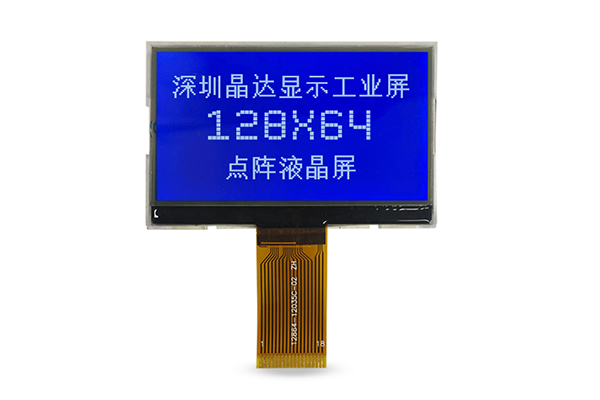
What is graphic LCD display screen?
A dot matrix screen is a display medium composed of dense and independently controllable pixel matrices. Each pixel unit can be independently turned on or off, enabling flexible display of text, curves, icons, data tables, and simple dynamic graphics. In the industrial display field, dot matrix screens are mainly divided into two core categories: graphic LCD display and monochrome LCD display, both of which belong to professional industrial-grade LCD display products, different from consumer-grade color TFT LCD screens and commercial display panels.
The monochrome LCD display adopts a single-color black-and-white or blue-white display mode, with a pure pixel matrix structure, no color distortion, and ultra-high contrast. It is the most widely used dot matrix screen type in industrial flow-temperature, high-dust, and strong-interference environments. The graphic LCD display retains the flexible pixel matrix control capability of dot matrix screens, it supports multi-grayscale display on the basis of monochrome, can present layered graphic information, and balances display richness and industrial stability.
The Advantages of Graphic LCD Display in Industrial Equipment
The widespread popularity of dot matrix screens in industrial scenarios stems from their targeted optimization for industrial production characteristics. Compared with traditional segment LCD screens and ordinary civilian LCD display products, monochrome graphic LCD display have prominent advantages in display flexibility, environmental adaptability, operational stability, power consumption control, and cost performance, which fully meet the rigorous requirements of industrial equipment for display terminals.
1. Ultra-High Display Flexibility
Industrial equipment involves complex and diverse display content, including real-time operating parameters, equipment running curves, fault code prompts, parameter setting interfaces, and production data statistics. Traditional segment LCD screens can only display fixed preset characters and numbers, which cannot adapt to the dynamic and diversified display needs of modern industrial equipment. In contrast, dot matrix industrial LCD screens represented by graphic LCD display and monochrome lcd display have unparalleled display flexibility.
2. Extreme Environmental Adaptability
Industrial production environments are far more complex than civilian scenarios, with common adverse conditions such as high temperature, low temperature, high humidity, dust pollution, electromagnetic interference, and vibration impact. Ordinary consumer-grade LCD display panels are prone to display failure, color cast, screen flicker, and even structural damage in harsh industrial environments, which cannot guarantee long-term stable operation. Industrial dot matrix screens, especially high-qualitymonochrome lcd display products, are professionally optimized for industrial harsh environments, with excellent environmental adaptability.
3. High Stability and Long Service Life
Industrial equipment requires long-term continuous operation, and the stability and service life of display terminals directly affect the overall failure rate and maintenance cost of the equipment. Ordinary civilianLCD display panels have a short service life, prone to pixel failure, backlight aging, and display attenuation after long-term operation, and require frequent replacement and maintenance, increasing the downtime loss and maintenance cost of industrial production.
In the field of industrial equipment display, the core demand of enterprises is long-term stable operation, environmental adaptability, and low comprehensive cost, rather than redundant color and high-definition performance. As professional industrial display solutions,graphic LCD display and monochrome lcd display dot matrix screens make up for the defects of traditional segment LCD screens and civilian ordinary LCD display products.