

The Advantages and Application Fields of LVDS Display
LVDS display has undergone decades of market development and has become the preferred interface solution for large LCD screens in industrial, automotive, medical, and commercial fields. LVDS as a high-reliability differential signal transmission technology, LVDS perfectly solves the pain points of traditional parallel display interfaces such as high electromagnetic interference, short transmission distance, high power consumption, and poor stability.
What is LVDS LCD Display Technology?
LVDS TFT LCD DISPLAY is a low-voltage differential signal transmission standard launched in accordance with IEEE industry specifications, specially designed for high-speed digital video signal transmission. Different from single-ended signal transmission adopted by traditional RGB parallel interfaces, LVDS relies on paired differential lines to transmit data signals. It uses a 3.5mA constant current source drive mode, with a signal voltage swing of only 350mV, which is far lower than the 3.3V or 5V voltage swing of traditional single-ended interfaces . This low-voltage and low-current working mode fundamentally optimizes the power consumption and signal interference problems of display transmission systems.
A complete LVDS display system consists of three core parts: a transmitter, differential transmission cables, and a receiver. The transmitter converts parallel video data output by the main control chip or graphics processor into serial differential signals; the differential cable group transmits high-speed data; the receiver restores the serial signals to parallel data and outputs them to the LCD screen driver board.
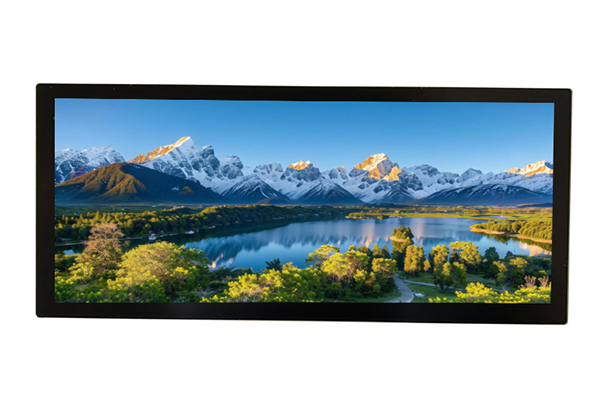
Core Technical and Application Advantages of LVDS LCD Displays
The long-term market dominance of LVDS LCD displays stems from their unique technical advantages, which precisely match the high stability, high adaptability, and low failure rate requirements of industrial and commercial display scenarios. Compared with traditional parallel RGB interfaces and emerging MIPI interfaces, LVDS has irreplaceable comprehensive advantages in medium and large-sized display equipment and complex working environments.
1. Ultra-low Electromagnetic Interference
Electromagnetic interference (EMI) and external signal noise interference are the main factors causing display screen flicker, color distortion, and screen flashing. LVDS adopts differential signal transmission logic, and the two paired signal lines always transmit equal and opposite signals. During the transmission process, the electromagnetic fields generated by the two lines cancel each other out, which greatly suppresses electromagnetic radiation.
2. Low Power Consumption and High Energy Efficiency
Power consumption control is a key indicator of display equipment performance, especially for vehicle-mounted, portable medical, and outdoor commercial display devices with limited power supply.
3. Simple Wiring and High System Integration
The traditional parallel RGB interface requires more than 20 signal lines including data lines, clock lines, and control lines, resulting in complex wiring, large cable volume, and high wiring difficulty. LVDS only needs 4-6 differential pairs plus a small number of ground lines and clock lines to complete high-definition video signal transmission, which greatly simplifies the internal wiring of the equipment.
4. Wide Temperature Adaptation and Ultra-high Operational Reliability
Most industrial and vehicle-mounted display scenarios require equipment to work stably in extreme temperature environments. LVDS LCD displays support a wide working temperature range of -30°C to +85°C, and can maintain stable signal transmission and normal picture display in high-temperature workshops, low-temperature outdoor environments, and vehicle operating environments with drastic temperature changes.
Main Application Fields of LVDS LCD Displays
Relying on the above technical advantages, LVDS LCD displays have completely covered medium and large-sized high-reliability display scenarios, and have formed stable and mature application layouts in industrial control, automotive electronics, medical equipment, commercial display, and smart consumer electronics fields
1. ndustrial Control and Intelligent Manufacturing Field
Industrial control is the most core application field of LVDS LCD displays, covering industrial all-in-one machines, PLC control screens, industrial touch displays, equipment operation panels, and intelligent monitoring terminals.
2. Automotive Electronics and Vehicle Display Field
With the rapid development of intelligent vehicles, vehicle-mounted display equipment such as instrument clusters, central control large screens, passenger entertainment screens, and rear-view monitoring screens have put forward higher requirements for display stability, safety, and environmental adaptability.
3. Medical Equipment and Precision Medical Display Field
Medical display equipment such as medical monitors, B-ultrasound instruments, electrocardiograph displays, and surgical navigation screens require ultra-high picture clarity, stability, and zero signal interference, because display accuracy is directly related to medical diagnosis results and surgical safety.
4. Commercial Display and Intelligent Digital Signage Field
Commercial display scenarios such as shopping mall advertising screens, office building digital signage, exhibition hall display screens, and outdoor intelligent publicity screens require long-term uninterrupted operation, high-definition picture display, and strong environmental adaptability . LVDS LCD displays are widely used in commercial display terminals due to their high cost performance and stable performance.
5. Smart Home and Consumer Electronic Display Field
In the consumer electronics field, LVDS LCD displays are widely used in smart TVs, notebook computer screens, intelligent refrigerator display screens, and smart door lock display terminals . As a mature high-speed transmission technology, LVDS can meet the high-definition display needs of consumer electronic products, and its simplified wiring helps reduce the thickness and weight of products, realizing the lightweight and thin design of smart terminals.
For the Future Development Trends of LVDS LCD Display Technology. With the upgrading of industrial intelligence, vehicle intelligence, and high-end medical equipment, the market has put forward higher requirements for display resolution, transmission speed, and environmental adaptability. As a mature and iterative technology, LVDS is also constantly upgrading and optimizing. At present, high-speed LVDS technology has realized stable transmission of 4K high-definition signals, and further improves bandwidth and transmission efficiency through multi-lane superposition technology.
The core advantages of LVDS DISPLAY lie in high speed, low power consumption, low noise, and long-distance transmission. Therefore, it not only dominates modern display interfaces, but also plays a key role in communication, industry, automotive, medical, aerospace and other fields that require high signal integrity