

TFT LCD Display Resolution: HD,Full HD,4K and Higher Resolution
In the modern display industry and LCD display, with its mature manufacturing process, stable display performance and extremely high cost-effectiveness, has always held a dominant position in the commercial, industrial and household display markets. And resolution, as the core indicator for evaluating the display quality of TFT display, directly determines the clarity of the picture, the expressiveness of details and the visual experience.
The TFT display, or thin-film transistor display, is the current mainstream driving technology for LCD displays. The traditional passive matrix LCD display has drawbacks such as slow response speed, image ghosting, and low contrast. However, the TFT technology achieves precise control of each pixel by matching independent thin-film transistor switches to each pixel, significantly improving the screen's response speed, contrast, and color reproduction. For TFT LCD display resolutions are classified into various levels based on the total number of pixels, including high definition, full high definition, 2K, 4K, 8K, etc. Different resolutions correspond to different technical parameters, display effects and application scenarios, and are also the core basis for the differentiated selection of high-resolution TFT displays.
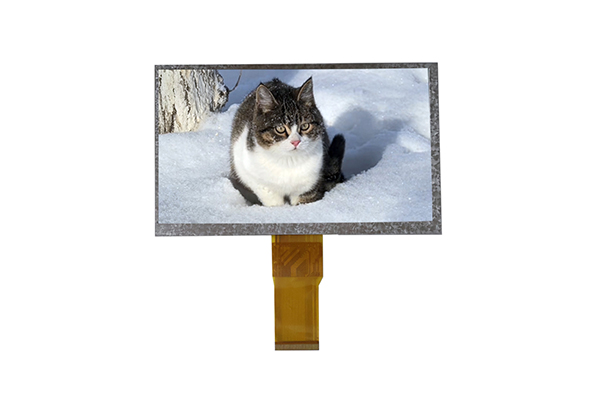
1. HD 720P
High-definition resolution is the basic high-definition standard in the LCD display industry. The standard parameters are 1280×720 pixels, with a total pixel count of approximately 920,000. As an entry-level high-definition specification, 720P is an upgraded version of traditional standard-definition screens, completely solving the problems of blurry and lacking details in standard-definition images, and meeting basic visual display requirements.
LCD displays with this resolution mostly adopt conventional TFT driving schemes, which are technologically mature, have low production costs, and have excellent power consumption control. Due to the relatively low pixel density requirements, the screen yield rate is extremely high, and they have extremely high cost-performance ratios. In terms of application scenarios, 720P high-definition screens are mainly suitable for low-end home TVs, old-fashioned computer monitors, entry-level portable devices, ordinary commercial advertising screens, basic industrial control displays, and other terminal products with low image quality requirements and a focus on practicality.
2. FHD 1080P
Full HD resolution is currently the most popular mainstream display standard in the market, with a standard parameter of 1920x1080 pixels, and a total pixel count of approximately 2.07 million. Compared to the 720P pixel total, it has increased by more than double. The picture clarity and detail expression have achieved a qualitative leap.
The TFT display equipped with 1080P specifications has undergone years of technical optimization, with mature and stable driving circuits, precise color reproduction, smooth dynamic picture response, and no obvious ghosting or graininess. In application fields, 1080P full HD LCD display is widely used in most civilian and mid-range commercial terminals such as home smart TVs, mainstream computer monitors, notebook screens, vehicle control screens, mid-range commercial displays, medical auxiliary display equipment, etc.
3. 2K Resolution QHD
The 2K resolution represents an advanced high-definition standard. The industry's common standard parameters are 2560×1440 pixels, with a total pixel count of approximately 3.69 million. Compared to 1080P, the pixel density has increased by about 70%, resulting in more detailed picture details and a stronger color gradation effect.
The 2K-level high-resolution TFT display has higher requirements for TFT display screen driving accuracy, liquid crystal molecule arrangement technology, and the uniformity of the backlight module. The screen has a higher pixel transparency rate, with no blurring at the screen edges and sharp text display. It can precisely present image texture details and is suitable for fine visual operation scenarios.
4. UHD 4K
4K ultra-high definition is the mainstream benchmark specification in the current high-end LCD display market. The standard civilian parameter is 3840x2160 pixels, with a total pixel count of up to 8.3 million, which is 4 times that of 1080P full high definition and 9 times that of 720P high definition. It is a typical high-resolution TFT display.
The TFT display of 4K specification adopts high-precision thin-film transistor array technology, with extremely small pixel pitch. Under the same screen size, the picture detail presentation capability reaches a new height. It can accurately restore picture textures, light and shadow layers, and color details, effectively eliminating picture graininess and jaggedness.
5. 8K and higher ultra-high resolution
The 8K resolution, as the next-generation ultra-high-definition standard, has parameters of 7680x4320 pixels, with a total pixel count exceeding 33 million. It is four times that of a 4K screen and 16 times that of 1080P. It belongs to the top-level high-resolution TFT display specification.
8K-level TFT display represents the current top level of LCD display technology. The extreme pixel density makes the picture infinitely close to the real visual effect of the human eye, capable of capturing micrometer-level picture details, with natural and smooth color transition, and without any visual graininess. This type of ultra-high-resolution TFT LCD screen adopts a new generation of precise TFT DISPLAY array manufacturing process, ultra-wide color gamut calibration technology and high-speed signal transmission technology, solving technical problems such as increased power consumption, uneven heat dissipation and signal delay caused by high pixel count.