

How large-sized LED Displays Are Redefining the World Cup Football Experience
The 2026 FIFA World Cup kicked off not just with the roar of the crowd in sports venue , but with a digital innovation. As the ball rolled onto the pitch in city, a extremely large in size 2,000-square-meter LED display system illuminated the legendary stadium, completely transforming the viewing experience and bringing about a more perfect visual feast. This is not just about bigger screens; it is a huge shift in how we consume live sports, driven by cutting-edge LED technology and complex display ecosystems.
The question is no longer whether we can see the game, but how immersive and seamless the visual experience can be. The answer lies in the colossal LED displays that have become the digital heartbeat of the stadium.
The newly installed digital system covers every angle of the fan’s line of sight. Two massive main screens, totaling nearly 400 square meters, provide crystal-clear action replays and real-time data. But the real game-changer is the 1,000-square-meter inner arc surround screen, which wraps around the interior of the stadium, creating a 360-degree visual immersion that puts fans right in the middle of the action.
Question: What powers these massive displays and ensures they don’t fail during a crucial penalty kick?
Answer: The answer lies in the "Display Driver IC" and the chip technology behind them. These chips are the brains of the operation. For instance, the ICND1065S driver supports a staggering 7,680Hz refresh rate and maintains current accuracy within ±2%. This high refresh rate is crucial for broadcast television, eliminating the flicker that cameras often pick up, ensuring that a global audience sees a flawless, smooth image and animate. These chips are the unsung heroes that stabilize the "LED screen" and allow "high brightness" in the harsh outdoor sunlight, ensuring the "display" remains vivid and visible.
Beyond the Pitch: The Power of the Perimeter
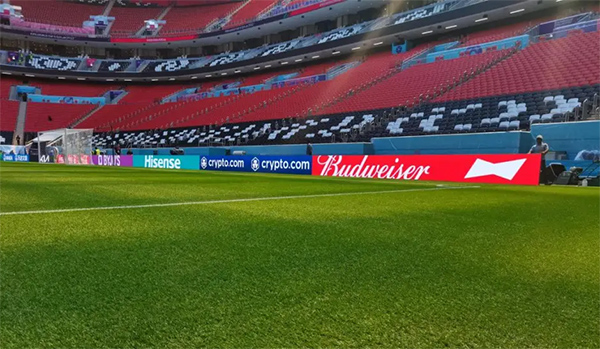
While the central displays dominate the field of vision, the unsung workhorse of the modern sports broadcast is the perimeter LED display. These long, scrolling panels that line the edge of the pitch are a critical component of the event’s commercial and visual ecosystem.
Question: How do these perimeter displays enhance the event differently from the main screen?
Answer: Their function is dual-purpose. The "perimeter display" provides an uninterrupted, ultra-wide viewing angle for advertising, ensuring brand visibility from every seat in the house and, more importantly, on every broadcast camera shot. Technologically, they are built to be rugged. For a sport like football, these "LED panels" must be "anti-collision" and highly elastic to protect players who might slide into them.
They are also designed for "high brightness" to beat direct sunlight. The "perimeter LED" screens work in concert with the massive main displays and even the outer facade screens, creating a cohesive digital ecosystem.
A Global Stage for LED Innovation
This digital spectacle is a testament to the global supply chain of the LED industry. The technology is built for resilience and ultimate performance. For example, to meet rigorous UEFA and FIFA standards, displays come with IP65 waterproofing and dual-redundancy on power and signals to prevent a single point of failure.
Question: With such high risks, how do the stadiums ensure these systems remain reliable for the entire tournament?
Answer: The focus is on redundancy and support. The systems are engineered with fail-safes, such as dual-power and signal backups. Meanwhile, the LED component technology is specifically designed to handle extreme conditions. After special treatment, they are built to resist moisture, UV rays, and temperature swings, reducing the risk of screen failure mid-match.
The Future of audience
The 2026 World Cup Football demonstrates that the future of sports is digital. The seamless integration of "ultra-high refresh rate" displays, robust perimeter LED signage, and the intricate "LED display driver chips" working behind the scenes has created a visual symphony for fans. As the technology advances, the line between being in the stadium and watching from home will continue to blur, all driven by the relentless pursuit of the perfect pixel.
The Commercial Engine: Unlocking the Value of the Perimeter LED Display
While the colossal central screens capture the spectacle of the game, it is the unbroken ribbon of LED technology circling the pitch that serves as the tournament’s most potent commercial engine. These perimeter LED displays have evolved far beyond simple digital billboards; they are now sophisticated, dynamic platforms that represent a multi-million-dollar ecosystem of advertising, data, and brand engagement. Their commercial value is not just in visibility, but in the precision and adaptability they offer to a global audience.
The Dynamic Advertising Canvas
The primary commercial power of a perimeter display lies in its ability to replace a static board with a dynamic, high-frequency advertising medium. A single LED perimeter system can effectively replace dozens of traditional static boards, unlocking the potential for unlimited rotating sponsors and real-time content integration. This capability transforms the advertising inventory from a fixed asset into a flexible, high-turnover revenue stream. Unlike a painted wall, an LED display allows a stadium or tournament organizer to sell the same advertising space to multiple brands within a single match, maximizing the commercial potential of every minute of play.
This dynamism enhances the effectiveness of the advertisements themselves. The motion, color, and animations of LED technology capture attention 23% better than static images, according to industry analysis. For sponsors, this translates into significantly higher visibility and brand recall among the captive audience of millions watching both in the stadium and via broadcast. The revenue generated from these prime placements is substantial; for major events like the World Cup, perimeter LED display advertising is a cornerstone of commercial success, with UEFA, for example, generating a record €586 million in advertising revenue for Euro 2024, largely driven by this technology.
Beyond the Static Banner: Real-Time Adaptability and Fan Engagement
The true commercial genius of the perimeter LED display is its real-time flexibility. The technology is broadcast-ready, featuring a high refresh rate (often exceeding 3840Hz) that ensures a flicker-free, crystal-clear image for 4K television cameras. But more importantly, the content on these displays is no longer fixed. Dynamic content rotation allows for a range of commercial strategies, from standard sponsor rotations to time-sensitive activation. A brand can trigger a specific graphic or promotional code in the moments following a goal, capitalizing on peak emotional engagement. This capability transforms the display from a passive billboard into an active marketing channel that can react to the ebb and flow of the game itself.
Beyond standard advertising, perimeter LED displays open new revenue streams. Venues can sell premium screen time for special announcements, fan-generated content, or even local community messages. This integration blurs the line between advertising and entertainment, creating a more engaging experience for the fan while generating additional income for the venue and rights holders.
The Game-Changer: Virtual Advertising and Targeted Markets
Perhaps the most revolutionary commercial advancement is the integration of virtual overlay technology with the physical perimeter LED display. This technology uses AI to superimpose different advertisements onto the LED boards in the broadcast feed, allowing viewers in different regions to see completely different sponsors while the fans in the stadium see the physical LED content.
This is a paradigm shift for commercial value. A single match can now generate four to eight separate advertising feeds, multiplying the available inventory without any change to the physical hardware. A brand can target its specific market—German viewers see German sponsors, Asian viewers see Asian sponsors—maximizing the relevance and return on investment for every advertising dollar. This technology, used at scale during Euro 2024, allows clubs and tournament organizers to monetize their international reach far more effectively. The physical LED board remains the critical infrastructure, while the virtual layer unlocks a new dimension of targeted, globalized commercial potential.
Proving the Value: Measurement and Return on Investment
The final pillar of the commercial value proposition is the ability to accurately measure the return on investment (ROI). Gone are the days of vague estimates; modern analysis platforms can track perimeter advertising with frame-by-frame precision. They measure the exact duration of logo exposure on screen, the percentage of screen space occupied, and the visibility quality—whether a logo was fully visible or partially obstructed. Crucially, they can also measure the context of the exposure, placing a premium value on advertisements visible during high-value moments like goal replays or penalty kicks.
This data is converted into actionable metrics then, such as media-equivalent value and broadcast impressions. This empowers sponsors and rights holders alike with proof of performance, moving beyond "trust me" reports to hard data that justifies the investment. The ability to provide sponsors with concrete, calculable indicators is what turns a one-off campaign into a long-term, lucrative partnership. The perimeter LED display is not just an advertising board; it is the cornerstone of a modern, data-driven sports marketing strategy, offering a level of accountability and performance that is unmatched in the world of sports sponsorship and advertising.