

What are Full Lamination and Semi Lamination of Touch Screen?
In the modern LCD displays industry, TFT display with touch screen and LCD display lamination technology determines core product performance, including visual clarity, touch sensitivity, structural durability and environmental adaptability. For industrial control equipment, commercial display terminals, consumer electronics and automotive display screens, full lamination and semi lamination are the two mainstream bonding processes that dominate the market. Most buyers and engineers struggle to distinguish their structural differences, performance gaps, cost variations and application scenarios, which often leads to improper product selection and increased use costs.
Basic Overview of Touch Screen Lamination Technology
Touch screen lamination refers to the process of bonding the touch sensor panel, cover glass and LCD display module together through professional optical adhesive and precision equipment. The core purpose is to fix the structural layers of the display screen, optimize optical transmission performance, and stabilize touch signal output. The quality of the lamination process directly affects the comprehensive experience and service life of touch LCD display devices.
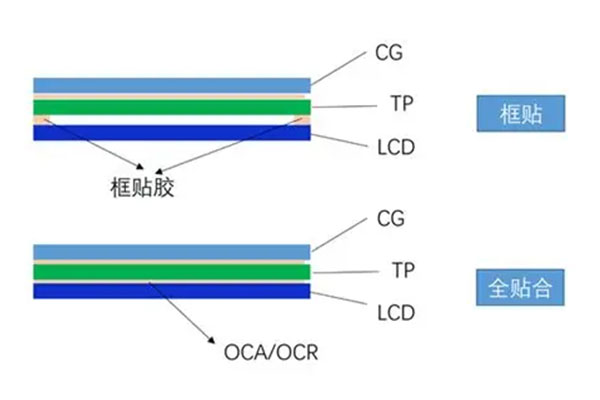
What is Semi Lamination (Frame Lamination) of Touch Screen?
Semi lamination, commonly called frame lamination or edge bonding, is a traditional and cost-effective touch screen and LCD displays bonding process. Its core feature is partial bonding only at the screen border, while the central display area retains a natural air gap between the touch panel and LCD display module.
In the production process of semi lamination touch LCD screens, manufacturers use high-strength double-sided adhesive tape or sealing glue to fix the four edges of the touch screen cover glass and sensor layer on the middle frame of the LCD display module. The adhesive only acts on the non-display black border area of the screen, and the entire visible display area is not filled with any optical adhesive, forming a complete air inter layer between the touch layer and LCD display layer.
What is Full Lamination Construction?
In a fully laminated display, the optical adhesive fills every micron of space between the touch sensor and the LCD panel. The adhesive layer adds only 25 to 50 microns (0.025 to 0.05 mm) to the overall thickness. This makes the finished module approximately 0.1 mm to 0.7 mm thinner than a semi-laminated screen
The adhesive used in full lamination can be either:
1. OCA (Optical Clear Adhesive): A solid, pre-cut adhesive film applied between layers. This method is faster, involves no curing time, and creates minimal thermal stress on components 35 OCA is typically used for smaller-sized displays.
2. OCR (Optical Clear Resin): A liquid adhesive dispensed and then UV-cured. This method can accommodate curved or uneven surfaces and is often used for larger displays.
Both OCA and OCR achieve light transmittance exceeding 90%, preserving display clarity and brightness .
Full Lamination vs Semi Lamination: Core Parameter Comparison
To intuitively distinguish the differences between the two processes, the following core parameter comparison covers structure, performance, cost, maintenance and application dimensions, covering all key evaluation indicators of touch screen and LCD display selection.
In terms of internal structure, semi lamination has border bonding + middle air gap, while full lamination has full-area seamless bonding with zero air gap. In terms of light transmittance, semi lamination is 80%-85%, and full lamination can reach more than 90%. For touch response speed, semi lamination has a slight delay, while full lamination responds instantly. In terms of dust and water resistance, semi lamination is poor and easy to enter dust and moisture, while full lamination has excellent sealing performance. In terms of production cost, semi lamination is low, and full lamination is high. In terms of maintenance difficulty, semi lamination is easy to repair with low cost, and full lamination is difficult to repair with high cost. In terms of service life, semi lamination is relatively short, and full lamination is longer and more stable.
Summary
Full lamination and semi lamination are two indispensable core processes in the touch screen and LCD display industry, with their own unique advantages and applicable scenarios. Semi lamination relies on low cost and easy maintenance to occupy the mid-to-low-end display market, meeting the basic use needs of most ordinary display equipment. Full lamination relies on seamless integration, excellent optical performance, high-precision touch and strong environmental resistance to become the preferred process for high-end display equipment.