

TFT Display vs LCD Display: What Are the Main Differences?
In reality, there is a clear inclusive relationship and core technical distinction between TFT and LCD technologies. Understanding the fundamental differences between TFT displays and LCD displays is critical for making informed purchasing decisions, optimizing device performance, and matching display solutions to specific application scenarios. This article breaks down their working principles, structural designs, visual performances, power consumption, and application scenarios to clarify how these two mainstream display technologies differ and where each excels.
What Are TFT Displays?
TFT stands for Thin Film Transistor, which is not an independent display technology but an advanced driving and optimization technology built on the basis of LCD structures. TFT displays are essentially active-matrix LCD displays that integrate a tiny thin-film transistor for each individual pixel on the screen. Each transistor acts as an independent switch, responsible for precisely controlling the voltage and signal of a single pixel. This core structural upgrade completely subverts the passive working mode of traditional LCD displays.This active-matrix architecture allows each pixel to hold its state while others refresh. TFT displays are therefore a subset of LCD displays, but with vastly superior performance. Almost every LCD made today—from smartphone screens to 65-inch 4K TVs—is actually a TFT-LCD. When someone says “TFT screen,” they typically mean an active-matrix LCD.
What Are LCD Displays?
LCD stands for Liquid Crystal Display, a general category of flat-panel display technology that has dominated the consumer electronics market for decades. LCD displays rely on the unique physical properties of liquid crystal molecules to modulate light and generate visual images. The core structure of traditional LCD displays includes a backlight module, glass substrates, liquid crystal layers, color filters, and polarizing films. Unlike self-luminous display technologies such as OLED, LCD displays do not produce light independently. Instead, they use a fixed backlight source, and adjust the arrangement of liquid crystal molecules through electrical signals to control the transmittance of light, thereby forming different colors, brightness levels, and image details.
An LCD panel consists of a backlight, polarizing filters, a liquid crystal layer, and electrodes. When voltage is applied, the crystals twist to block or transmit light, creating pixels. Traditional LCD displays include passive-matrix types (like STN or TN) and active-matrix types (like TFT). The key limitation of early LCDs was slow response time and narrow viewing angles because passive-matrix designs addressed entire rows or columns of pixels at once.
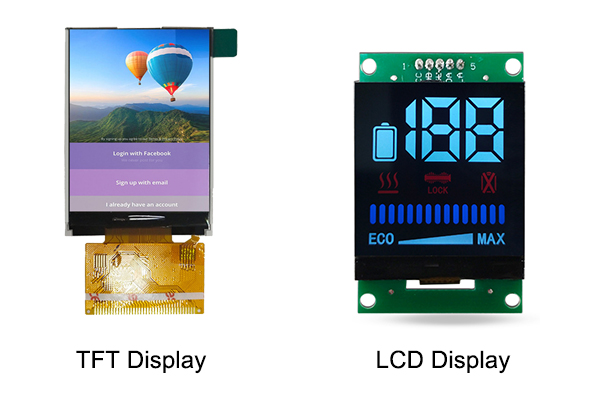
Core Technical Differences Between TFT Displays and LCD Displays
The essential gap between TFT displays and traditional passive-matrix LCD displays lies in the pixel driving mechanism, which further leads to comprehensive differences in display performance, structural design, and user experience. The following sections elaborate on the key distinctions from four core parts.
Pixel Driving Mechanism
The driving mode is the fundamental difference separating TFT displays and conventional LCD displays. Traditional passive-matrix LCD displays adopt a row-column cross-scanning driving method. The system scans each row and column of pixels in a fixed cycle, and all pixels share circuit signals. Since multiple pixels share electrode circuits, signal interference and crosstalk are inevitable during the scanning process. When displaying dynamic images or high-resolution content, the shared circuit cannot provide stable and continuous voltage support for each pixel, resulting in unstable pixel status.
Response Speed and Dynamic Display Performance
Response speed refers to the time required for display pixels to switch between bright and dark states, which directly determines the dynamic display effect of the screen, especially for fast-moving images such as games, videos, and sports footage. Traditional LCD displays have a very slow response speed, usually above 100 milliseconds. Due to the passive scanning mode, pixel signal update has obvious delays, and the liquid crystal molecules cannot flip in time when the screen content changes rapidly. This leads to serious ghosting, blurring, and trailing phenomena in dynamic scenes, making traditional LCD displays unable to adapt to high-frame-rate dynamic display scenarios.
Viewing Angle Performance
Viewing angle is a key indicator of display screen practicability, representing the angle range in which the screen can maintain accurate color and brightness when viewed from non-frontal perspectives. Traditional passive-matrix LCD displays have extremely narrow viewing angles, with an effective viewing range of only 30 to 45 degrees frontally. When the user slightly tilts the perspective, the screen will experience severe color distortion, brightness attenuation, and even color inversion. This defect makes traditional LCD displays only suitable for single-user frontal viewing scenarios and cannot meet multi-person viewing or multi-angle observation needs.
Power Consumption and Energy Efficiency
In terms of power consumption, traditional LCD displays have dual-sided characteristics. For static simple display content such as single-color text and fixed patterns, passive-matrix LCD displays have lower power consumption because of their simple circuit structure and low signal operation load. However, when displaying dynamic, high-resolution, and multi-color content, the continuous cyclic scanning of passive circuits increases signal loss and power consumption, resulting in low overall energy efficiency.
Shenzhen Jingda Display Technology Co; Ltd.,(JDA in brief) is established in 2015, with a team of 10 experienced engineers in the LCD display industry. Through our continue innovations, it has developed into a high-tech enterprise integrating R&D, manufactures and sells display modules and HMI solution. JDA is committed to the perfect integration of intelligent technology and display technology, our company focused on the field of LCD display, and is committing to providing clients with high cost-effective LCD display product and display application solution. The main products include small and medium size monochrome LCD display and LCM, 0.96-25 inch TFT and OLED LCM HMI solutions, and touch screen, control panel, backlight, etc. With more than 10 years development, Jingda display has rich experiences in LCD display field, meanwhile it has own R&D team and factory, and has certain advantages in product quality and innovation ability. We aim to be at the forefront of the LCD display technology industry, offering innovative and reliable products that meet the ever-evolving needs of the market.