

How to Distinguish LCD Modes for Transmissive, Transflective, Reflective?
LCD Displays remain one of the most dominant display technologies across consumer electronics, industrial equipment, automotive interfaces, and wearable devices worldwide. Unlike self-emissive display panels such as OLED and micro LED, LCDs do not generate light independently. According to LCD display transmission modes, we typically classify LCD displays into three types, including transmissive, transflective, and reflective. Each mode features unique optical structures, power consumption profiles, environmental adaptability, and application boundaries.
What is the Reflective LCD Display?
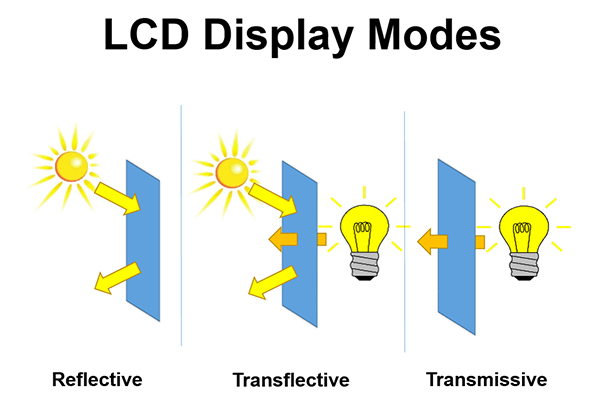
In reflection mode, ambient light is used to illuminate the display. There is no backlight source inside this kind of display. This is achieved by combining the reflector with the rear polarizer. It works best in outdoor or sunlight-readable environments. We can also find reflective display modes in graphic COG LCDs and character LCDs with positive display types. The most common devices using reflective LCDs are outdoor applications.
What is the Transflective LCD Display?
Transflective display is a hybrid of reflective and transmissive types. The transflective display combine backlight and ambient light to illuminate the pixels. They are combined with backlight and can be used for all types of lighting conditions. When there is sufficient external lighting, the backlight can be turned off to save power. In darker environments, backlight is turned on to provide a bright display. Transflective LCDs are commonly used in industrial and medical equipment.
What is the Transmissive LCD Display?
There is a transparent rear polarizer that does not reflect ambient light. They rely on the backlight to be visible. They work best under low light conditions with continuous backlight on. For this kind of display module, light emitting from the back of the display glass must pass by the LCD towards the front to light the pixels. TFT screen usually with transmissive display module more.
For the transmissive display, the most common devices not only using transmissive LCDs are smartphones, tablets, computer monitors, and television. They are also used in digital cameras, automotive displays, medical equipment, and on on.
Comparative Analysis: Transmissive vs Transflective vs Reflective LCD
To simplify display mode selection, we summarize the core performance differences of the three LCD modes across key dimensions. In terms of light sources, transmissive LCDs use only backlight, reflective LCDs use only ambient light, and transflective LCDs support dual light sources. For power consumption, reflective LCDs are the lowest, transflective LCDs are moderate, and transmissive LCDs are the highest.
In terms of sunlight readability, reflective and transflective modes perform excellently, while transmissive modes are poor. For low-light display performance, transmissive and transflective modes deliver high-quality images, while reflective modes are invalid. In color reproduction and resolution, transmissive LCDs rank first, followed by transflective LCDs, with reflective LCDs being the weakest. In terms of service life and stability, reflective LCDs are the best, transflective LCD displays are moderate, and transmissive LCDs are relatively limited by backlight aging.
Cost-wise, reflective LCDs are the most affordable, transmissive LCDs offer high cost performance for indoor scenarios, and transflective LCDs have the highest unit cost. This comprehensive comparison clearly defines the applicable scenarios of each mode: choose transmissive for indoor high-quality display, reflective for ultra-low-power bright-environment devices, and transflective for all-light-condition portable and outdoor devices.
Summary
Transmissive, reflective, and transflective LCD display modes are not superior or inferior in absolute terms; each is optimized for specific application scenarios and user needs.
1.Transmissive LCD display anchor high-quality indoor display with outstanding color and resolution performance, remaining the mainstream for fixed indoor display equipment.
2.Reflective LCD displays excel in ultra-low-power bright-environment display, providing reliable and cost-effective solutions for simple long-standby devices.
3.Transflective LCD display as an upgraded hybrid technology, break the environmental limitations of single-mode LCD display, becoming the core display choice for portable and cross-scenario outdoor devices.