

What is the Difference Between Resistive Touch Display and Capacitive Touch Display?
In today's digital world, touch screens have permeated every aspect of our lives, ranging from the smartphones in our pockets to the industrial control equipment in factory workshops. Compared to regular LCD displays, TFT LCD Screen can provide very clear images and text and has a shorter response time. The increasing application of TFT LCD displays has brought better visual effects to products. For the TFT display module, there are two touch type: Resistive Touch Display and Capacitive Touch Display.
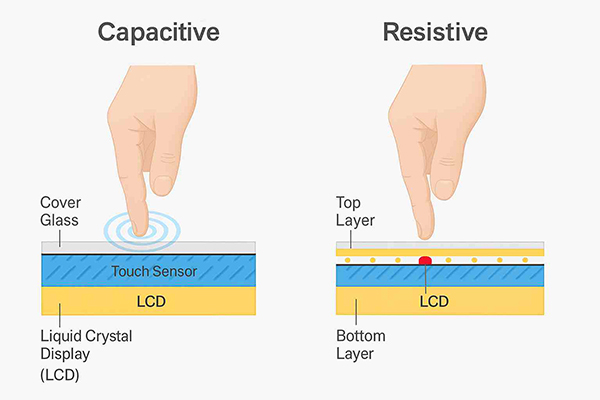
What is a Resistive Touch Screen?
Two layers of conductive ITO films, with tiny insulating points in between, do not touch each other normally; when pressed, the upper and lower films touch each other, forming a conductive circuit. The controller calculates the pressing coordinates based on the XY voltage. Resistive touch screens come in various variants such as four-wire, five-wire, and eight-wire. The numbers represent the number of circuit components connected to the controller. Among them, the four-wire resistive screen is the most common and economical solution, while the five-wire resistive screen provides higher durability and accuracy through the design of a constant voltage at the bottom layer.
The typical structure of resistive touch screens consists of: a bottom layer made of glass or organic glass substrate, onto which a transparent conductive layer (usually indium tin oxide ITO) is coated, an intermediate layer, and an upper layer of multi-layer resin coating, with the outer surface treated through hardening.
What is a Capacitive Touch Screen?
The surface layer of the screen has a conductive ITO capacitor layer. The human body has a weak biological current. When a finger touches it, the human body and the screen electrodes form a coupling capacitor. The four corner electrodes capture the current difference to calculate the touch point.
The basic structure of a capacitive touch screen consists of a four-layer composite glass panel. The outermost layer is a chemically or physically strengthened protective glass (with a hardness of 6H, 7H, 8H or above), and the inner surface and the inter-layer of the glass are each coated with an ITO conductive layer.
Key Feature Comparison Table
|
Item |
RTP Touch Screen |
CTP Touch Screen |
|
Touch Method |
Just press and apply pressure |
Must be conductive human body/capacitive pen, with touch sensing function |
|
Touch tool |
Nails, plastic pens, gloves, any hard objects |
Hands-free, conductive capacitive pen; ordinary gloves/plastic pen are ineffective |
|
Multi touch |
Supporting a single point incurs extremely high costs, and achieving multiple points requires additional efforts. |
Native support for multi-point, gestures (zooming, sliding, multi-finger) |
|
Transmittance |
Low (75% - 80%), multi-layer film reflection is strong |
High (85% - 90%), showing clearer and more transparent. |
|
Surface Hardness |
The surface of the soft mask is prone to scratches and requires a protective film. |
Tempered glass cover plate, scratch-resistant and wear-resistant |
Advantages of resistive screens
1. Can be operated by any object. Suitable for industrial scenarios with protective gloves or rubber gloves.
2. Extremely high positioning accuracy, suitable for cash registers, industrial equipment, and drawing instruments.
3. Not afraid of moisture or slight water vapor. The preferred choice for outdoor industrial equipment.
4. Low price, simple driver, and low power consumption.
Disadvantages of resistive screens
1. Requires forceful pressing, resulting in poor operation experience
2. The film surface is prone to scratches and will malfunction after long-term pressing
3. Does not support multi-finger gestures and cannot zoom in or out
4. Poor light transmission, resulting in blurry screen appearance
Advantages of Capacitive Touch Screen
1. Smooth touch operation with a pleasant feel, supporting multi-point gestures
2. Anti-scratch tempered glass surface, durable and resistant to scratches
3. Transparent display with better color perception
4. No physical pressing wear and tear, longer lifespan for household digital devices
Disadvantages of capacitive screens
1. Can only be used with bare hands or a dedicated capacitive pen. Ordinary gloves prevent usage.
2. Water or condensation will cause erratic movements and accidental touches.
3. Low temperatures and thick oil stains will significantly reduce sensitivity.
4. More costly and unstable in humid industrial environments.
Applications
Typical applications of resistive touch screens
Resistive touch screens, with their low cost, flexible input and strong anti-interference capabilities, remain the preferred choice in the following scenarios:
Industrial control equipment: The factory environment is subject to dust, oil contamination and electromagnetic interference, and operators often wear gloves.
POS cash register systems: Require pen signatures and operation with gloves on
Medical equipment: High requirements for reliability and hygiene cleanliness
Automobile navigation systems: Drivers may operate with gloves on
Public inquiry terminals: Such as self-service ticket machines, ATMs, etc.
Outdoor equipment: Exposed to harsh environments such as dust and moisture
Typical applications of capacitive touch screens
Capacitive touch screens, with their advantages of multi-point touch, high sensitivity, and excellent display quality, dominate the following scenarios:
Smartphones and tablets: requiring smooth gesture operations and multi-point touch experiences
Consumer electronics: smart home appliances, wearable devices
High-end human-machine interfaces: devices that require modern interaction experiences
Medical equipment: scenarios that require fast and intuitive input
Touch displays: applications with high requirements for display effects
Future Development Trends
Capacitive touch screens, with their multi-point touch control, high sensitivity and excellent display effects, have become the mainstream technology in the consumer electronics market. However, resistive touch screens still maintain an irreplaceable position in specific fields such as industrial control, medical equipment and public facilities.
In recent years, technological development has shown a trend of integration and optimization. Industrial-grade capacitive TFT display are gradually overcoming traditional shortcomings such as electromagnetic interference, water mist and glove operation through self-developed touch control algorithms and scenario-based optimization. At the same time, resistive TFT screens are also improving durability and accuracy through material and process improvements.
About Jingda Display Company
Shenzhen Jingda Display Technology Co; Ltd., is established in 2015, with a team of 10 experienced engineers in the LCD display industry. Through our continue innovations, it has developed into a high-tech enterprise integrating R&D, manufactures and sells display modules and HMI solution. JDA is committed to the perfect integration of intelligent technology and display technology, our company focused on the field of LCD display, and is committing to providing clients with high cost-effective LCD display product and display application solution. The main products include small and medium size monochrome LCD display and LCM, 0.96-25 inch TFT&OLED LCM HMI solutions, and touch screen, control panel, backlight, etc. With more than 10 years development, JDA has rich experiences in LCD display field, meanwhile it has own R&D team and factory, and has certain advantages in product quality and innovation ability.