

What is the Difference Between Graphic LCD Display and Segment LCD Display?
In industrial electronics, consumer appliances, automotive devices, and portable measurement equipment, LCD displays and LED displays are the most common human-machine interaction carriers. Among all mainstream display types, graphic dot matrix displays and segment displays (also known as segment code screens) are the two most widely used low and medium-end display solutions. In the field of LCD displays, two fundamental technologies have stood the test of time: segment displays and graphic dot matrix displays. While both serve the purpose of presenting visual information to users, they operate on fundamentally different principles and excel in entirely different applications.
What Is a Segment Display?
A segment display is a fixed-structure display device prefabricated with independent segment electrodes on the screen. Its internal structure is preset according to fixed display contents, and the screen surface is divided into several independent non-adjustable display segments. The most common structure is the seven-segment structure for digital display, and some customized models are equipped with fixed icon segments such as battery power, signal strength, temperature symbols, and function indicators.
The working principle of segment displays is much simpler than that of dot matrix displays. The driving circuit only needs to input high and low level signals for specific segments. When the corresponding segment electrode is powered on, the segment is lit to form fixed numbers or symbols; when powered off, it is hidden.
What Is a Graphic LCD Display?
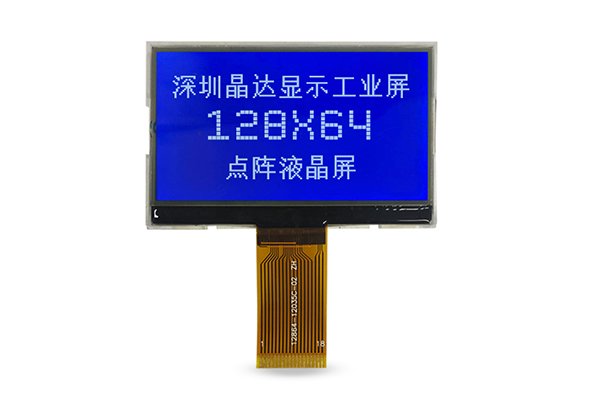
A graphic LCD display is a full-custom pixel-level display device composed of an orderly grid of independent pixel units arranged in fixed rows and columns. Each pixel on the screen is independently controlled by the driving circuit, which can be individually turned on or off without being restricted by fixed character or segment structures. Common resolution specifications include 128x32, 128×64, 192×64, 128x128, 240×128 and other standard models, covering small and medium-sized display size needs.
The core working principle is based on matrix scanning driving technology. The display chip controls the row and column circuits to perform cyclic scanning on pixel points, and adjusts the on-off state and gray scale of each pixel according to the input display data.
Comparison Summary
|
Parameter |
Segment LCD Display |
Graphic LCD Display |
|
Structure |
Predefined segments/electrodes |
Grid of individually controllable pixels |
|
Content Flexibility |
Fixed, limited to designed characters/icons |
Unlimited, software-defined |
|
Resolution |
Low |
High, pixel-dependent |
|
Drive Complexity |
Simple |
Complex |
|
Readability |
Excellent contrast |
wide angles Varies by technology |
Parameter Segment Display Graphic LCD Display
Combined with the above differences in performance, cost, and functions, the two displays have completely differentiated application scenarios in the industry. Accurate selection can maximize product performance and optimize cost control.
1.Typical Application Scenarios of Graphic Dot Matrix Displays
Graphic dot matrix displays are suitable for products that require complex human-machine interaction, diversified display content, and functional iteration expansion. The core application scenarios include industrial control touch screens, intelligent testing instruments, medical detection equipment, POS payment terminals, handheld data collectors, and medium and high-end smart home devices. These scenarios need to display multi-line text, complex menus, data curves, and customized icons, and often need to upgrade display functions with product iteration, which exactly matches the flexible display advantages of dot matrix screens.
In addition, in automotive on-board auxiliary displays, environmental monitoring equipment, and intelligent terminal devices that need dynamic data update and graphic display, graphic dot matrix displays are also the mainstream choice, which can meet the high requirements of product visualization and interactive experience.
2.Typical Application Scenarios of Segment Displays
Segment displays are mainly used in cost-sensitive, single display function, and fixed content display equipment. The typical scenarios include household appliances such as water heaters, induction cookers, air conditioners, and washing machines, as well as smart water meters, electric meters, gas meters, remote controls, electronic thermometers, and low-end portable measuring instruments. These products only need to display fixed numbers, simple state icons, and parameter values, without complex graphic interaction and function iteration, which can maximize the cost advantage and stability of segment screens.
Meanwhile, in industrial equipment indicator lights, power detection devices, and long-term standby monitoring equipment that pursue low power consumption and high durability, segment displays are also the preferred display solution in the industry.
How to Choose the Right monochrome LCD Display?
In short, the essential difference between graphic dot matrix displays and segment displays lies in display flexibility and structural scalability. Segment LCD displays rely on fixed segment structures, with low cost, low power consumption, high stability, and single functions, focusing on fixed digital and simple symbol display scenarios. Graphic dot matrix displays rely on independent pixel matrix control, with flexible and diverse display content, strong scalability, and slightly higher power cons