

What is Graphic Dot Matrix STN and FSTN Display Mode?
In all monochrome display options, STN (Super Twisted Nematic) and FSTN (Film Compensated Super Twisted Nematic) display modes stand out as the most mature, reliable, and practical choices for monochrome LCD display applications worldwide. Unlike advanced TFT displays that feature redundant high-color performance and excessive power consumption for basic display scenarios, STN and FSTN graphic dot matrix screens focus on core practicality, delivering exceptional stability, low power consumption, and cost efficiency. This article comprehensively analyzes the inherent advantages of STN and FSTN display modes, clarifying their unique value in commercial and industrial display deployments, and explaining why these two technologies continue to dominate the graphic lcd display market after decades of technological iteration.
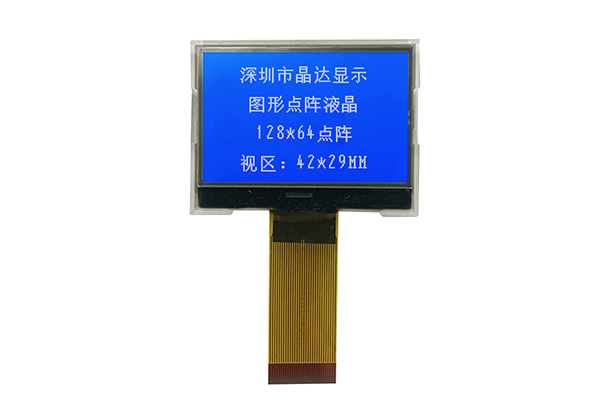
What is STN and FSTN Technology?
Traditional TN (Twisted Nematic) LCD screens suffer from severe limitations in pixel resolution, viewing angle, and display uniformity, making them unable to support high-precision graphic lcd display output. To address these pain points, STN technology was developed with an optimized liquid crystal twist structure, increasing the liquid crystal twist angle from 90 degrees of traditional TN screens to 180–270 degrees. This structural upgrade enables STN screens to achieve accurate pixel control and continuous graphic display, laying the foundation for practical dot matrix graphic display applications.
FSTN is an upgraded iteration of STN technology, introducing a professional optical compensation film to eliminate the inherent color shift and contrast attenuation defects of traditional STN displays. As a optimized monochrome LCD display solution, FSTN inherits all the core advantages of STN while fixing its technical shortcomings, achieving ultra-high contrast, zero color deviation, and wide-viewing-angle display effects. Both STN and FSTN belong to passive matrix graphic lcd display technologies, featuring no built-in transistor pixels, simple circuit structure, and strong environmental adaptability
Advantages of STN Graphic Dot Matrix Display Mode
As a classic mainstream technology in the monochrome LCD display field, STN graphic dot matrix screens have maintained strong market vitality relying on their mature technology, ultra-high cost performance, and stable operational performance.
Compared with segment code LCD screens and traditional TN dot matrix screens, STN graphic lcd display products achieve revolutionary progress in graphic presentation capability. The optimized super-twisted liquid crystal structure enables independent and accurate control of each dot matrix pixel, supporting the display of complex graphics, custom fonts, data curves, and multi-line text. For industrial instruments, smart home control panels, and portable detection devices that require real-time data and graphic overlay display, STN screens can present clear and complete graphic information without pixel distortion or blurring.
As a passive display technology, STN screens do not rely on high-power backlight drive and complex pixel circuit systems. Their working power consumption is far lower than TFT color screens and even mainstream low-power OLED screens. In actual operation, the static display power consumption of STN monochrome LCD display modules can be controlled at the milliwatt level, and the standby power consumption is almost negligible. Compared with FSTN, TFT, and other display technologies, STN screens have lower material costs, simpler processing procedures, and higher product yield. This makes STN graphic lcd display products have absolute cost advantages in mass procurement and batch production.
The Application of STN and FSTN Graphic LCD Display
STN Display Main Application Scenarios
With ultra-high cost performance and stable basic performance, STN monochrome LCD display is widely used in cost-sensitive basic display equipment, including civil smart home devices, ordinary industrial control instruments, traditional measuring tools, electronic scales, water and electricity meters, and low-end portable electronic devices. These scenarios have low requirements for display contrast and viewing angle, but high requirements for cost control and long-term stability, which exactly fits the core advantages of STN graphic LCD display.
FSTN Display Main Application Scenarios
FSTN graphic LCD display is oriented to high-end industrial and commercial scenarios with high display requirements, including automotive instrument displays, industrial human-computer interaction terminals, medical monitoring equipment, precision analytical instruments, outdoor unattended monitoring terminals, and commercial payment terminals. These scenarios require high screen clarity, wide viewing angle, strong environmental adaptability, and stable long-term operation, and the comprehensive performance of FSTN monochrome LCD display can fully meet professional application standards.
STN and FSTN display modes represent the most mature and practical technical solutions in the field of monochrome LCD display. STN graphic LCD display relies on ultra-high cost performance, ultra-low power consumption, and long-term stability to become the preferred choice for basic industrial and civil display scenarios. FSTN, as an upgraded version of STN technology, achieves ultra-high contrast, wide viewing angle, and zero color deviation display effects on the basis of retaining all the advantages of STN, meeting the high-standard display needs of high-end industrial, medical, automotive, and commercial scenarios.