

What Is a Polarizer and Its Core Role in LCD Display?
Polarizers are invisible yet indispensable optical components that serve as the foundational building blocks of all LCD (Liquid Crystal Display) devices. While most consumers focus on screen resolution, refresh rate, and color accuracy, the polarizer is the unsung hero that makes visible images possible on LCD panels. Without high-quality polarizers, LCD screens cannot produce contrast, control light transmission, or render clear, vibrant visuals.
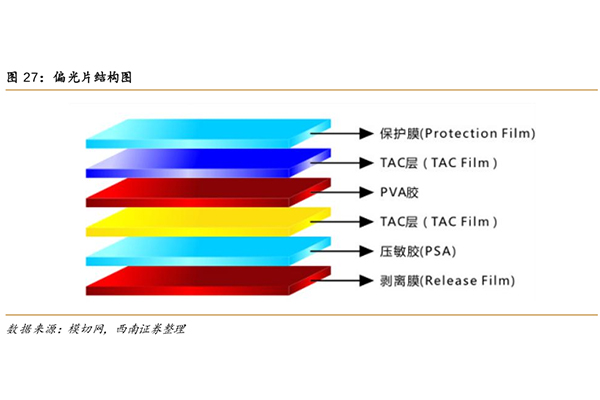
What Is a Polarizer?
A polarizer, also known as a polarizing filter or polarizing film, is a specially designed thin optical film used to filter and control the vibration direction of light waves. To fully understand its function, one must first grasp the fundamental characteristics of natural light. Natural light emitted by backlight sources, sunlight, or indoor lighting is unpolarized, meaning its electromagnetic waves vibrate randomly in all vertical directions relative to the light propagation direction.Although it is extremely thin, it determines whether light can pass through the display, making it possible for images, text, and colors to appear on the screen. Unlike OLED displays that generate their own light, LCDs rely on a backlight. Without polarizers, the light produced by the backlight would simply pass through the display uncontrollably, making it impossible to create visible images.
Core Types of LCD Polarizers
Based on installation position, optical function, and application scenarios, polarizers used in LCD displays are mainly divided into two core categories, which work in pairs to complete the entire light control process. Different types of polarizers are tailored to match diverse LCD panel structures and usage environments.
1.Lower Polarizer (Back Polarizer)
The lower polarizer is installed between the LCD backlight module and the liquid crystal layer, serving as the first optical gate for backlight transmission. Its primary task is to convert the unpolarized uniform light emitted by the backlight into unidirectional polarized light. The backlight module produces high-brightness, multi-directional scattered light, which is completely disordered and cannot be modulated by liquid crystal molecules. The lower polarizer filters out all irregular light vibrations, outputting stable single-axis polarized light for subsequent liquid crystal regulation.
2.Upper Polarizer (Front Polarizer)
The upper polarizer is attached to the outer side of the liquid crystal layer, facing the user’s viewing direction. Its polarization axis is installed at a 90-degree vertical angle to the lower polarizer, forming a cross-polarization structure. As the second optical gate of the LCD panel, it cooperates with liquid crystal molecules to control the final light output and form screen contrast and images. The upper polarizer focuses on contrast optimization, anti-glare performance, and viewing angle stability. It filters the light modulated by liquid crystal molecules, blocking invalid light and outputting precise light signals corresponding to pixel voltages.
How Does a Polarizer Work in an LCD?
The working principle can be divided into several simple steps.
Step 1: Backlight Produces White Light
The LED backlight generates bright white light.
This light contains waves vibrating in every direction.
Step 2: Rear Polarizer Filters the Light
The rear polarizer allows only one polarization direction to pass.
At this stage, all transmitted light vibrates in a single plane.
Step 3: Liquid Crystal Rotates the Light
The liquid crystal molecules twist according to the electrical signal applied to each pixel.
Different voltages create different rotation angles.
This is the heart of LCD image formation.
Step 4: Front Polarizer Controls Transmission
The front polarizer analyzes the polarization angle.
Depending on how much the liquid crystal rotated the light:
--Light passes completely
--Light passes partially
--Light is completely blocked
These varying brightness levels produce grayscale and full-color images.
Summary
Polarizers are the core optical foundation of all LCD display screen, undertaking the key tasks of light polarization filtering, light transmission control, contrast formation, and anti-interference display. As a passive display device, the entire imaging logic of LCD displays relies entirely on the cooperative work of upper and lower cross polarizers and intermediate liquid crystal molecules. The quality of polarizers directly determines core LCD display indicators including screen brightness, contrast, color accuracy, viewing angle, and service life.