

What are the Three Manufacturing Processes for the Glass Cover Plate?
Glass cover plates are indispensable protective and decorative components for consumer electronics, automotive displays, smart home devices, and industrial touch screens. Serving as the outermost interface between electronic devices and users, they undertake core functions such as scratch resistance, drop resistance, light transmission, and aesthetic presentation. The performance, appearance durability, and application scenarios of glass cover plates are entirely determined by their manufacturing processes.
In the modern precision manufacturing industry, the production of high-quality glass cover plates mainly relies on three mature and mainstream processes: float glass process, overflow down-draw process, and chemical strengthening processing. Each process has unique technical principles, production advantages, performance characteristics, and targeted application fields. Understanding these three core processes is essential for electronics manufacturers, procurement engineers, and industry practitioners to select suitable glass cover plate materials and optimize product quality.
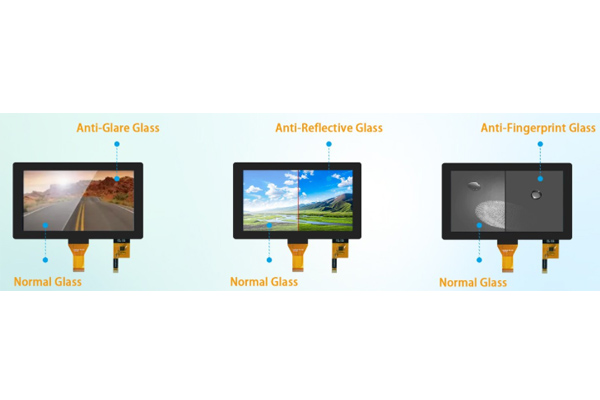
Anti-Reflective Coating (AR)
Untreated glass reflects about 8% of visible light – 4% from each air-to-glass interface. For displays, that reflection washes out contrast and forces users to increase brightness, draining battery. AR coating reduces reflection to under 1% per surface.
AR coating uses thin-film interference. Layers of materials with alternating refractive indices – typically silicon dioxide and niobium pentoxide- are deposited on the glass. Each layer is exactly one-quarter wavelength of visible light thick. Light reflecting from the top and bottom of each layer interferes destructively, canceling out the reflection.
The deposition method is electron-beam evaporation or sputtering inside a vacuum chamber. Glass covers are loaded onto rotating domes or planetary fixtures. The vapor travels in straight lines and condenses on the cool glass.
A typical AR stack has 4 to 7 layers. More layers give broader bandwidth (covering entire visible spectrum) but increase cost and cycle time. Quality inspection measures reflectance with a spectrophotometer. Good AR coatings show less than 0.5% average reflection from 450nm to 650nm.
Anti-Fingerprint Coating (AF)
Oily fingerprints are the enemy of any touchscreen. AF coating makes the glass oil-repelling and hydrophobic (water-repelling). Fingerprints wipe off easily, and smudges are less visible.
The coating is a fluoropolymer --typically a perfluoropolyether (PFPE) derivative. Application methods vary. Vacuum evaporation is common for high-volume production. A small crucible containing solid PFPE is heated inside a vacuum chamber. The material evaporates and bonds chemically to the glass surface, forming a mono layer about 2 to 5 nanometers thick. Wet spraying and thermal curing works for lower volumes. The liquid AF solution is sprayed or spin-coated onto glass, then baked at 120°C to 150°C for 30 minutes. The result is similar but slightly less durable than vacuum-deposited AF.
Durability is measured by a steel wool abrasion test. A 1kg weight with steel wool pad rubs back and forth across the coated surface. Good AF coatings survive 3,000 to 5,000 cycles while maintaining a water contact angle above 100 degrees. Untreated glass has a contact angle around 30 degrees – water spreads out.
Anti-Glare Coating (AG)
Glare comes from specular reflection – smooth surfaces reflecting light like a mirror. AG coating creates a microscopic texture that diffuses reflected light. The result is a matte finish that remains readable under bright sunlight or overhead lighting.
Two methods exist. The first is chemical etching. The glass is dipped in a bath of hydrofluoric acid or ammonium bifluoride. The acid selectively attacks the glass surface, creating random peaks and valleys. The roughness is controlled by acid concentration, temperature, and dwell time. After etching, the glass has a frosted appearance. The second method is spray coating of silica nanoparticles. A suspension of nanoparticles is sprayed onto the glass and baked. The particles self-assemble into a rough layer. This method offers better uniformity but lower abrasion resistance than etched AG. AG reduces clarity slightly because light scatters in transmission as well as reflection. For high-resolution displays, a compromise AG with moderate roughness (Ra 0.1 to 0.3 micrometers) is common.
Conclusion
The float glass process, overflow down-draw process, and chemical strengthening process constitute the three core technical pillars of modern glass cover plate manufacturing. Each process plays an irreplaceable role in the industrial chain, covering the full-range production needs from low-cost mass production to high-end precision customization.
With the continuous upgrading of consumer electronics towards lightweight, foldable, and high-definition display, the three major processes are also constantly iterating and optimizing. The overflow process is developing towards thinner thickness and higher flatness, the float process is continuously improving surface precision to narrow the performance gap with high-end processes, and the chemical strengthening process is evolving towards deeper stress layers and higher impact resistance. For global electronic manufacturers, a clear understanding of the characteristics of the three processes is the key to selecting high-cost-performance glass cover plate products and optimizing product core competitiveness.